Jul 19, 2010

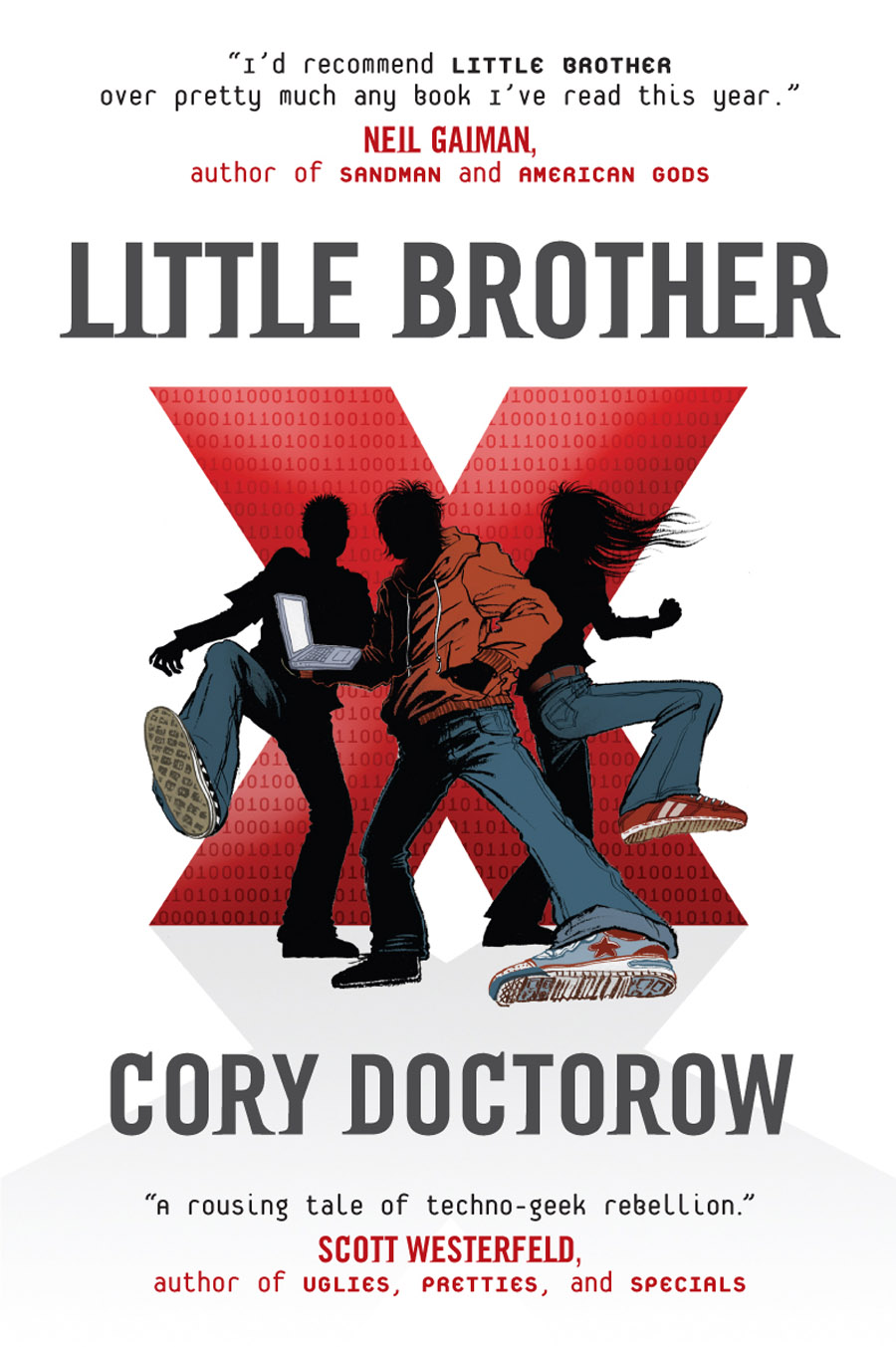
Little Brother by Cory Doctorow

Little-BrotherI am no longer an e-book virgin.

I have just finished reading Cory Doctorow’s Little Brother, which you can purchase through your local bookstore or if you have an e-reader or Kindle for PC you can download it here legally and for free in multiple formats. Cory does this with all of his novels – that’s right all for FREE.

If you have trouble understanding this concept check out his explanation here.

I have been sceptical about e-readers.  I thought I was destined to be the one of the last of a dying breed of people – those brought up on paper books. Indeed I struggle at reading long pdf’s and in the past if even if a book existed free or in text/ html  I much preferred to read it in paper format.

E-readers and e-reading software I think has changed that, especially for me.  I am now considering the Kindle (one of my greatest frustrations with reading Little Brother was that I had to lug the laptop around, not as I expected, eye strain from reading off the computer screen)or if possible a cheaper reader that can handle multiple formats.

But about Little Brother

You might have guessed by the title that the book is a riff off Orwell’s 1984 and you’d be right.  The story is one of resistance against the state but set in very near future ( it’s set after   9/11 , but the technology used is  I think very current)it’s what might happen to American freedoms if another attack were to occur on American soil.

As far as I can tell Little Brother is  Doctorow’s first young adult novel, the protagonist is Marcus, a 17 year old computer and tech geek. While playing an ARG(Alternate Reality Game) with school mates Marcus is caught in a DHS (Department of Homeland Security) dragnet, after a terrorist attack in his city.  Marcus is smart and has a good understanding of his constitutional rights, it’s his defence of these rights that really propels the story:

"What have you got to hide?"

"I've got the right to my privacy," I said. "And I want to speak to an attorney."

"This is your last chance, kid. Honest people don't have anything to hide."

"I want to speak to an attorney." My parents would pay for it. All the FAQs on getting arrested were clear on this point. Just keep asking to see an attorney, no matter what they say or do. There's no good that comes of talking to the cops without your lawyer present. These two said they weren't cops, but if this wasn't an arrest, what was it?

In hindsight, maybe I should have unlocked my phone for them.

Source: Little Brother, end of chapter 3

Marcus ends up being interred in a Guantanamo bay like facility an action that propels him into becoming a rebel with a cause.

What did I like?

The story plays to my left leaning liberal sensibilities.  It highlights everything that is worrying about western society’s quick turn to the right, to the climate of fear promoted by governments that see fear and security as election winning platforms.  The book may be set in an American context, but it has applications for a far wider audience.  Take cc camera surveillance in the UK or indeed the railroading of the Internet Filter in Australia ( or even more sinister, the Ozlog affair).

Doctorow’s writing was  fast paced, exciting and easy to read.  Like other Young Adult novels I have read, this one didn’t strike me as being any less of a rollicking good read for that fact.  There’s a bit of violence, a sex scene and description of torture so it’s not Alice in Wonderland, but it is pitched at 15 to 17 year olds.  I found some of the info dumps distracting from the flow of the book, but these were both interesting and necessary in there own right, especially considering what the book is intended to be, beyond just an action packed tale.

There’s more to this book than the story

While both 1984 and Little brother can be described as a fight for justice, and  liberty against the oppressive state, Little Brother is also something different.  1984 is a warning, a parable about what might occur (indeed some may say Orwell was almost prescient in some of his storytelling).  Little brother is simultaneously  a  story, a manual for resistance against an oppressive state and an attempt to get teens to look at the double edge nature of new technology.  Contained within it pages are references to real world resources and technologies for guarding your privacy or avoiding electronic surveillance.  Indeed the book has been most recently translated into Persian by Iranian activists in the hope that it might inspire a response in Iranian youth.  The book contains wealth of historical information on civil disobedience, enough hopefully to whet the young adolescent thirst for knowledge.

Skeptics and fans of reality will, I think enjoy Cory’s tone, here’s an example-my emphasis:

Which is why I prefer to inject a little randomness into my attacks on gait-recognition: I put a handful of gravel into each shoe. Cheap and effective, and no two steps are the same. Plus you get a great reflexology foot massage in the process (I kid. Reflexology is about as scientifically useful as gait-recognition).

Little Brother, Chapter 1

So do yourself a favour, buy the book and/or download it for free.

Just read it, I don’t think you’ll be sorry.

Edit: Please find the  link (right, save as) to copyright free (Australia)version of George Orwell's 1984 in .prc format for Kindle

Jun 1, 2010

Blind Faith by Ben Elton

blind I have had Blind Faith on my bookshelf for about 2 years - a gift from an acquaintance after I had bored them with my love of all things atheist and skeptical. “I think you’ll like this”, she’d said.

She was right.

Why did it take me so long to read? Well, while I am a fan of Elton’s work for television, i.e. Black Adder and the Young Ones. I had attempted to read Stark a number of years earlier and it had put me off his novels - not perhaps the fault of the writer.

I think, there can be a “right time” for books and their readers to meet. I can’t help but think that if I had come across Blind Faith earlier that it might not have resonated with me in quite the way it has.

Blind Faith is every Skeptics/Humanists nightmare come true - a dark comedic comment on a possible future. Elton has taken elements of modern society, stretched them for comedic value but left enough truth in them to ensure that any laugh the reader makes is tinged with nervousness...

Read the whole review  at Embiggen Books, Australia's number 1 skeptical bookstore.

Feb 1, 2010

BONESHAKER - a book review


What could be better than Steampunk?  Why, Steampunk plus Zombies of course.

And who do we have to thank for this delightful mix of subgenres?  The very appropriately named Cherie Priest(hey, I think her name is steampunk-ish).

boneshakerBoneshaker is Cherie's first novel set in The Clockwork Century world.  One thing that impresses me is that Cherrie seems to be very internet savvy.  Not only does she maintain a blog, but also a separate website specifically for the world in which her novels and short stories are set. 

I sincerely wish more writers would do this – developing extra content the builds on the back story/history of the world they create or alter.  One of the great things about reading JRR Tolkien is the immense history that serves as the foundation of his stories(indeed some may say its more interesting than the actual story). 

With the internet and the ease of creating websites I would think that there are almost limitless opportunities to enrich the experience of your readers/fans far beyond their reading of the novel.  The opportunity to blend world creation/immersion with merchandising and fan created content has me wondering why more writer don’t do this.  Check out JC Hutchins as a good example of what I am talking about.

Aside from Boneshaker, Cherie has a number of other written works floating about in the Clockwork Century world, including some with characters from Boneshaker.  Those who abhor the idea of book trilogies will be happy to know though, that Cherie’s subsequent works are not part of the same story line. 

If you are not convinced by my review (to follow) you can perhaps check out  Cherie’s writing for free.  She has a short story that you can read  here called Tanglefoot set in the Clockwork Century World. 

Now those of us not graced with good fortune of having studied American History, which no doubt includes a number of Americans, need not fear missing out on anything pertinent to the story.  I don’t think that we miss out on too much if we don’t know who Stonewall Jackson was.  Mind you with Wikipedia a click away, perhaps we should tae the time to find out – it can only enrich or understanding and immersion in the story.

Boneshaker is set in Seattle and takes place solely in that city.  Cherie gives the reader some broad brushstrokes  on the state of America at the time the novel is set but its not  necessary to enjoy the telling of the tale:

Stonewall Jackson survived Chancellorsville. England broke the Union’s naval blockade, and formally recognized the Confederate States of America. Atlanta never burned.

It is 1880. The American Civil War has raged for nearly two decades, driving technology in strange and terrible directions. Combat dirigibles skulk across the sky and armoured vehicles crawl along the land. Military scientists twist the laws of man and nature, and barter their souls for weapons powered by light, fire, and steam.

But life struggles forward for soldiers and ordinary citizens. The fractured nation is dotted with stricken towns and epic scenes of devastation—some manmade, and some more mysterious. In the western territories cities are swallowed by gas and walled away to rot while the frontiers are strip-mined for resources. On the borders between North and South, spies scour and scheme, and smugglers build economies more stable than their governments.

This is the Clockwork Century. It is dark here, and different.

[source]

The novel is named after a contraption invented by the protagonists husband – Leviticus Blue.  He’s part inventor, part mad scientist from the descriptions given in the novel(he is presumed dead for most of it).  The story unfolds that Leviticus invented the Boneshaker( a giant steam powered mining contraption) at the behest of Russian interests wanting mine through the ice in Alaska.  On a test run of his machine,, Leviticus tunnels under the city collapsing the banking area and unknowingly releases a gaseous substance that turns people into Rotters(zombies).  The affected part of the city is walled up and a once proud city limps by.

Which is where our protagonists Briar Wilkes(formerly Briar Blue) and her son Zeke come in.  Briar scratches out a living for herself and Zeke by working at a local processing where the inhabitants purify the city’s water (contaminated by the gaseous blight).  She bares the constant brunt of nasty practical jokes as the city’s populace hold her responsible for her husband’s activities.  She doesn’t tell Zeke much about his father and this withholding of information is what eventually acts as a catalyst for the story.  Zeke wanting to learn more about his father and recover the family’s good, name decides to go under the wall and as all steampunk, gun wielding motherly heroines are want to do, Briar follows him. 

What follows is a very cinematic adventure involving the discovery of a functioning underground society within the walls, smugglers airships and a quietly simmering conflict between a mad scientist named Minnericht and the regular denizens of the walled in city. 

Oh, and the ever present rotters.

While within the city people are confined to pressure sealed underground passages and rooms or if venturing above they must wear gas masks(whose filters last only a couple of hours) and protective clothing, sticking to the rooftops as the Rotters roam the streets and will swarm if enough noise is made. 

This setting struck me as an ideal setting for a tabletop miniatures or a console game(ala Bioshock - see, merchandising).

As with Leviathan the cover of Boneshaker ensnared me with its sepia toned woman in goggles. The interior of the book is interesting as well, brown ink on cream paper.

I like the isolated, industrial, apocalyptic feel of the novel.  There is some sense of the larger outside world, but it’s beyond the reach of the main characters. I also like the fact that the protagonists are not your usual fare – a teenage boy and his mother.  Briar is believable as the gun toting daughter of Sherriff  and Zeke is a convincing teenager(convinced of his own indestructibility).  The twist at the end was a surprise and one that I felt I should have seen coming but didn’t.

If I have any criticisms of the book it’s that I wanted more( I am not averse to trilogies).  I felt that there were more adventures to be had by Zeke if not Briar.  There was also a moment in the book where Zeke and Briar seemed to be just missing each other by hours – this bordered on frustrating as opposed to suspenseful for me.

The airships  didn’t feature as prominently as I hoped but I hear that one of Cherie’s following novels aims to rectify that situation.

All in all I think the book is excellent movie material- if we can get zombie pirates in Pirates in the Caribbean surely we can get steampunk zombies, no?


Upcoming novels set in the same alternate world:

Due out this year is the novel Clementine, which you can read about here and Dreadnought later in the year – a synopsis is here.

LinkWithin

Related Posts Plugin for WordPress, Blogger...