Showing posts with label Paolo Bacigalupi. Show all posts

Apr 14, 2015

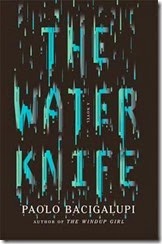
Book Review – The Water Knife by Paolo Bacigalupi

the-water-knifeI have enjoyed (if that’s the right word) Bacigalupi’s vision of the near future in his young adult works, Ship Breaker and The Drowned Cities.  In The Water Knife, he returns to adult fiction and by adult I mean that the story is reasonably complicated and deals with mature concepts.

The Water Knife depicts a near future where state and corporate factions fight for water rights in a crumbling South West America (Nevada, California, Utah, Texas Arizona). The situation is not quite open warfare, a federal government still exists but states act to protect their borders from refugees (Texans get it bad in this future) moving from the poorer states.

The story focuses largely on a reporter and a water knife(a trouble shooter / trouble starter for one of the states) as they become embroiled in a search for old water rights that could upset the well laid plans of powerful entities.  It’s fast paced, full of shootouts between gun toting Texans, Hispanic gangs and agent provocateurs from any entity in the market for making money off of misery.  There’s torture and violence of the kind you’d expect in a world of failing states who can’t supply their populace with clean water or sewerage and who have really given up on caring.

The Times anointed Bacigalupi as a successor to William Gibson, and while The Water Knife, isn’t cyberpunk, it’s a future unevenly distributed, with corporations and foreign powers beginning to carve out influence for themselves in a union that is slowly failing.  A slow apocalypse, an eco-thriller, an action adventure,The Water Knife is a fast paced and dirty look at what might happen when the water all but dries up and the lawyers are all but finished determining who owns the rights to what’s left.

I suspect that the novel is firmly grounded in some of the issues surrounding water rights in the South Western states today and The Water Knife has that edge of realism, the world seems only to have been extrapolated out by a number of decades. Indeed the kind of jockeying for access to rights observed in The Water Knife doesn’t appear to be that much different to what occurs with companies exploiting exploring for fracking opportunities in a number of countries.

It’s not message fiction (unless perhaps you don’t think there’s any climate change), it’s firmly bedded down in moral greyness  Indeed talking about distribution, it wouldn’t be hard to find situations and themes presented in The Water Knife existing in third world countries now or in the  last 20 or 30 years, the difference here is of course the setting is the US.

It was a quick read, enjoyable and interesting for its focus on a more plausible slow apocalypse.  This is good sci-fi examining the issues we face now and suggesting where we might end up.


This book  was an Advanced Reading Copy.


Did you enjoy this review? Would you like to read more? You can subscribe to the blog through a reader, by Email or Follow me on twitter.

Oct 5, 2012

Books and Art Daily features Robinson and Baccigalupi on Utopia In Science Fiction

cathcartMichael Cathcart interviews Kim Stanley Robinson and Paolo Bacigalupi on Radio National’s Books and Art Daily as part of a larger programme on Utopias. 

The Utopia in Science Fiction segement can be found here (8mb). 

The entire programme here.


Did you enjoy this review? Would you like to read more? You can subscribe to the blog through a reader,by Email or Follow me on twitter.

May 23, 2012

Book Review–The Drowned Cities by Paolo Bacigalupi

DROWNED-CITIESThe Drowned Cities is listed on some sites as the second in the Ship Breaker series. It’s a novel set in the same post climate change world as Ship Breaker rather than a “Book 2”. 
So don’t feel you have to have read Ship Breaker to get the full experience.  The Drowned Cities shares some locations and one character with Ship Breaker - the half-man Tool.

Quality fiction

The Drowned Cities is published in Australia by Atom, Hachette’s Young Adult brand.  To adult readers I would like to stress that this really has no impact on your enjoyment as an experienced or mature reader - it’s just quality fiction.

A future dystopia or comment on current events

With The Drowned Cities Bagicalupi builds upon and expands his vision of a dystopian future.  Like Ship Breaker the theme and content mirrors or comments indirectly( I never feel as though Bagicalupi is preaching) upon present day issues.  Ship breaker concentrated on a characters whose living was made stripping great containerships – a modern day inspiration, was no doubt something similar to The Chittagong Ship Breaking yards in Bangladesh.
The Drowned Cities’ theme centres squarely on the horrors of low scale internecine warfare in failed states and the sad reality of child soldiers and child victims of war.  Bagicgalupi brings the tale closer to home with his setting – The Drowned Cities being the flooded remnants of the eastern states of North and South Carolina.

The Tale

Mahlia and Mouse are War Maggots, orphans or refugees taken in by Dr Mahfouz who administers medical treatment to the families of Banyan Town.  Mahlia is a mixed raced daughter of a Chinese Peacekeeper and American/Drowned Cities mother, she’s had her right hand cut off by the Army of God due to this fact. 
Mouse is a country boy with a talent for dodging bullets.   While their situation isn’t ideal i.e. the town’s folk distrust her, it’s relatively safe.  Until that is, Tool,an escaping half-man, a genetic augmentation, draws militia pursuers to their quaint little piece of post apocalyptic hell.
What ensues is part comment on the stupidity and futility of war but also on the strength of  friendships borne out of survival.

Good Characterisation

Mahlia is the star of the story and I find her depiction as a strong female character particularly realistic and refreshing.  She’s a child of war, a survivor and her strength shines through, in her dedication to her friends and her will to go on. 
She displays cunning in her battles against forces that are physically stronger than her and is a refreshing hero in that she doesn’t need a gun or kick-arse martial arts moves to be strong.
We also get a better understanding of Tool as a rare breed of half-man, one that has overcome his genetic tendencies and training to obey his masters.
I also saw the depictions of the various militias in the book as comments on the some of the extremes of current American politics or political ideologies both in terms of religion and patriotism/nationalism.  No doubt some American readers might find Bagicgalupi’s future imaginings a little pointed.

Concerns?

The book deals with some fairly mature content.  I never felt as though Bagicgalupi was playing to the more violent aspects of the book though. There’s death and dismemberment but is well handled, repectfully depicted and fits well within the context of the world that’s been created. 
I can see Ship Breaker and The Drowned Cities as good jumping off points for discussions in a class mixing literature/reading with social studies.
The depiction of sex within the book, such that it is, is handled “off screen”.

Judgement 

A good addition to Bagicgalupi’s vision of a world in decline or crawling out of one.  There’s violence, poverty and calamity, but there’s also hope. There’s always a sense that the protagonists can prevail - not without consequences mind you, but that it is possible.
This book was provided to me by the publisher at no cost to myself


Did you enjoy this review? Would you like to read more? You can subscribe to the blog through a reader,by Email or Follow me on twitter.

Jan 15, 2012

The Bookshow profiles the The Windup Girl by Paolo Bacigalupi

windupI am still to read The Windup Girl but I enjoyed Ship Breaker and some of the short fiction in Pump Six.

Here’s Radio nationals profile of the book and the author:

Science fiction is often seen as a genre that presents a future, takes wild rides in cyber space, or delves into strange and confronting realms.

But rarely does a sci fi novel begin with a discussion about mangosteens.

Yet fruit, vegetables and dwindling food resources in a post oil-era world are the focus for award winning writer Paolo Bacigalupi's first published novel The Windup Girl.

Read More

You can download the short segment (7mb) here.

If you’re concerned about corporate farming this one will be right up your alley.


Did you enjoy this news post? Would you like to read more? You can subscribe to the blog through a reader,by Email or Follow me on twitter.

Purchase the eBook from Google eBooks Australia.

Aug 7, 2011

Book Review–Ship Breaker by Paolo Bacigalupi

ship
If you are part of the Speculative fiction scene, even in this great southern land of ours, you will have heard of Paolo Bacigalupi’s Ship Breaker .  It was published in the Northern Hemisphere last year and snared the 2011 Michael L Printz1 award and was a National Book(US) Award finalist.

Now Bacigalupi (BATCH-i-ga-LOOP-ee2) is no stranger to awards.  His adult novel The Wind Up Girl was awarded both a Hugo and a Nebula and Ship Breaker seems to feature some of the ideas that made that book a hit. 

Dystopia? Biopunk? Just great fiction
Ship Breaker , features a dystopian future world with human society living in the wreckage of an age of excess, where green technology is not some fanciful ideal but a necessity, a part of life. 

Our story starts on Bright Sands Beach where our protagonist Nailer, works on a “light crew”-clans of young workers who crawl the ducts of abandoned container ship wrecks3 searching for copper wiring and other salvageables. It’s here we learn of a future world where the disparity between rich and poor has grown, where the rich travel the seas on futuristic sailing vessels and the poor are left to fend for themselves scraping a living off the bones of the past. Where strange religious cults have merged with old religions, where genetically engineered dogmen are grown, bought and trained as loyal soldiers and where even blood bonded crew will sell you out if the price is right.

This less than ideal lifestyle is interrupted by the wrecking of a “swank”(rich person) ship on the Teeth(the submerged ruins of an old city).  Nailer finds a young girl alive on the wreck and from this point on he is faced with a number of life changing decisions; to kill her so that he and his friend can claim salvage, to sell her to the life cult who will harvest her organs, or to return her to her father for a reward - if indeed she is who she says she is. What ensues,however, is a classic adventure tale with far future, Biopunk colour.

What I think makes this great fiction for teens is the choices Nailer has to make, the decisions that he has to weigh.  Life for Nailer, just like the rest of us, is not a case of making clear decisions based on black and white thinking.  Sometimes what advantages us isn’t what’s right and sometimes when we do what we must our actions don’t bring us solace.

Teens Plus
Don’t let the YA/Teen categorisation put you adult readers off.  Reading this book encouraged me to buy the rest of Bacigalupi’s work.  He’s a good story teller and like Scott Westerfeld and Marianne de Pierres he has a talent for making his work exciting and relevant to adolescents and enjoyable for those with a little more life experience.

Content
I note that this book was recommended by the Wall Street Journal as a “good book for young men” in a side panel of the now infamous Darkness Too Visible 4 article that castigated the young adult genre for being too dark. 

Considering the thrust of that article I find its inclusion odd, because while well written, there are depictions of brutal familial violence and killing(though not without consequence, emotional and physical).  Perhaps this is just moral conservatism, which seems to have little trouble with young men reading about violence but frowns heavily on depictions/mentions of sex  - and it isn’t mentioned(sex) in Ship Breaker, child prostitution is faintly hinted at and the male and female protagonists share a quick peck, but that’s it. 

Recomendations
I’d suggest the book for the 14+ age group because of the violence. I’d also recommend it to adults who want to participate in a deftly imagined and painted and possible biopunk future.  It feels very plausible to me, a world where our technology allows us to survive and progress as a civilization but where not everyone gets access to that technology. A subtle warning with a glimmer of hope.
This book is a review copy provided by Atom Books


1. The Michael L. Printz Award is an award for a book that exemplifies literary excellence in young adult literature. It is named for a Topeka, Kansas school librarian who was a long-time active member of the Young Adult Library Services Association.
2.Start practicing the pronunciation now, I have a feeling Paolo is here to stay.
3. I am sure that Paolo used the ship breakers of in developing countries as for inspiration
4. An opinion article that I am sure was designed to be inflammatory, as it fails to establish with any degree of certainty what darkness is, uses Teen and child interchangeably, and fails to give produce any convincing evidence that the YA category is full of “kidnapping and pederasty and incest and brutal beatings”.

Did you enjoy this review? Would you like to read more? You can subscribe to the blog through a reader or Follow me on twitter.

LinkWithin

Related Posts Plugin for WordPress, Blogger...